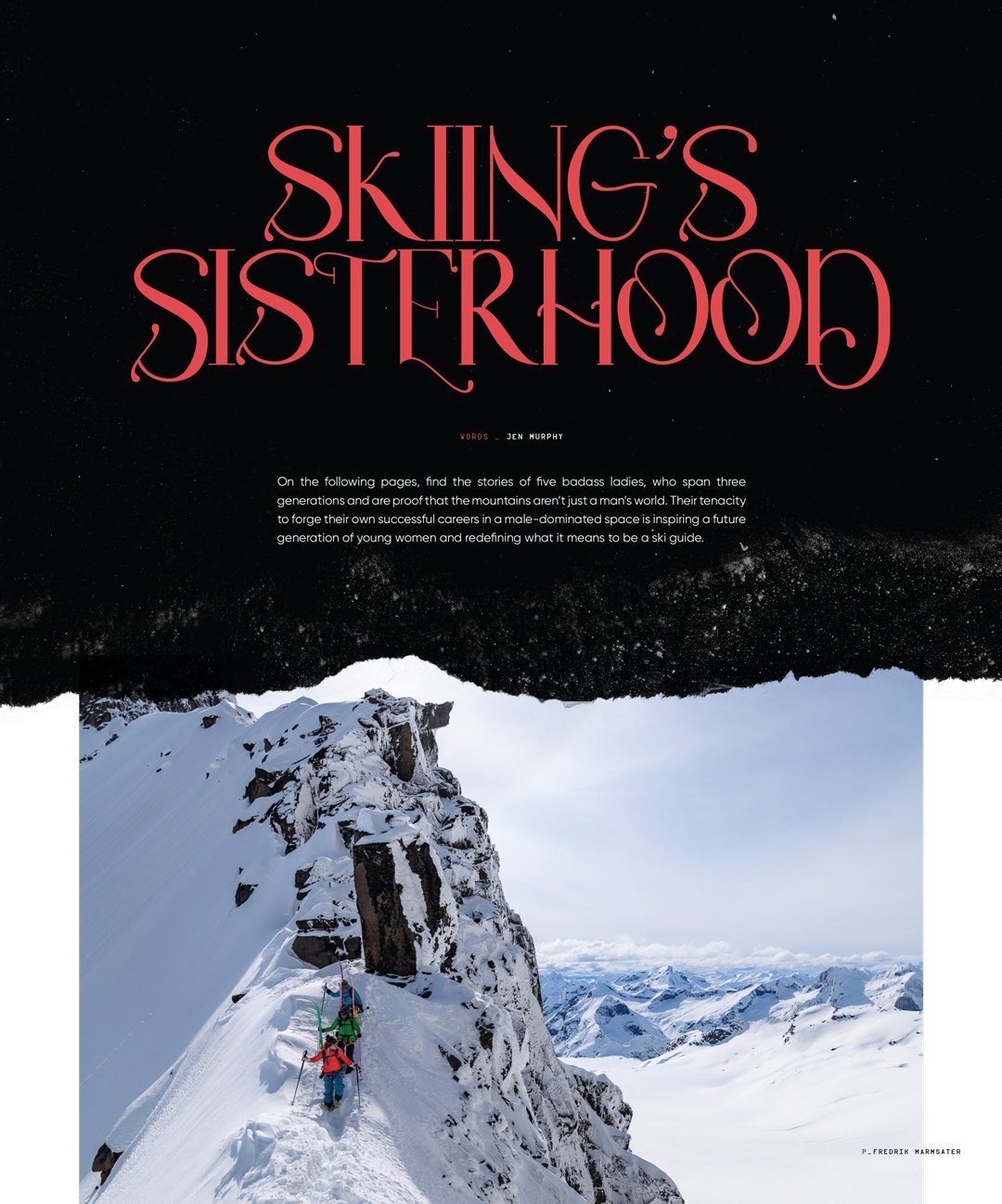
For Freeskier magazine, Jen Murphy profiled five women who span three generations and prove the mountains were never just a man’s world. Their tenacity in forging careers in a male-dominated space, she writes, is inspiring a future generation of young women and redefining what it means to be a ski guide.
Two of the five guide for Valdez Heli-Ski Guides.
Kirsten Kremer - "she just wants to ski the gnar"
Kirsten Kremer has been shredding gravity-defying lines in the Chugach since 1993, and nearly three decades on, her excitement for these peaks has not wavered. She knows the intricacies of the classic Chugach lines - Meteorite, the Sphinx - and loves nothing more than sharing them with her guests.
Most guides hop from company to company to work their way up. Kremer is the anomaly: she has stayed with the same operation. Her secret, Murphy writes, is stubbornness and determination. A Southern California native, she spent her teenage years chasing extreme skiing pioneers like Shane McConkey, Aaron McGovern and Kevin Andrews around Squaw Valley, and made the freestyle team.
When her then-boyfriend Dean Conway was invited to compete in the World Extreme Skiing Championships in Valdez in the early 90s, she tagged along and got hired as the event’s forerunner. That was her first experience heli-skiing, and she knew immediately she had to figure out a way to do more of it. She tried the ski-film route in Jackson Hole with Teton Gravity Research, but did not like the pressure of "being rad" on demand.
She returned to Alaska in 1997 determined to work for VHSG - then a year-old heli-ski operation started by two-time World Extreme Ski Champion Doug Coombs and his wife Emily. Guiding certifications barely existed. Her resume held an EMT license, whitewater rafting experience, instruction at the Alaska Mountaineering School, and serious ski chops.
“Every single day I would ask if they had a job and they would tell me no.”
She got hired as a waitress at the Tsaina Lodge instead, and skied in her free time. She entered the Extreme Ski Championships that year - and on day two of the competition, Emily Coombs called to say they needed a fueler. Kremer, 26, dropped out of the contest.
Fueling helicopters meant scrapping the waitress job, and with it her housing. Undeterred, she bought a tent and pitched it in a ditch in the Tsaina parking lot. Fueling gave her the chance to tail guide whenever there was an extra seat. The next year she was promoted to dispatcher.
“In the off-season, I basically stalked Doug and Emily. I would show up where they climbed to prove I had good rope skills. I desperately wanted to be part of their program. In life, you often get things by knowing people. I wanted them to know me.”
By 28, she was offered a guide position. There were women with more experience on their resumes, she says, but Emily liked that she was tenacious and saw that she was trainable - and probably worried she was not going to go away.
Having Emily Coombs as a mentor bolstered her confidence in a very male space. If guests question whether a pixieish, five-foot-four woman could haul them out of a crevasse, she starts cranking out one-arm pull-ups from the beams of the Tsaina bar to silence the doubts. She has made grown men cry, scolding them for not following instructions - and earned a loyal following for her ability to encourage and progress guests on terrain.
“A lot of aspiring young guides spend $50,000 on an AMGA certification, then realize guiding is hard work and go sell real estate. Get your avalanche education and medical training, and get an entry-level job fueling helicopters, tuning skis or working the front desk. People do not hire you for your certification - they hire you for your hard work and because you are fun to be around.”
Brooke Edwards - the other side of extreme
Brooke Edwards measures an epic day in the mountains not by how many runs or how much vertical her guests score, but by how many times they laugh. For her, it is not about the coolest lines - it is about the stoke.
“It is the Howards of the world - the guests who cry because they are so moved by the scenery - that make me want to guide.”
She ranks a day skiing with an 80-year-old named Howard among her best ever: they skied a flat 100 feet in the time the rest of the group did six laps. Three turns, then look up at the mountains in awe.
For years the exterior image of the heli-ski industry was intimidating, Murphy notes - but Edwards never subscribed to the extreme-skier-only notion. Her willingness to hang back with mellow skiers helped get her foot in the door. Frequently asked to ski the resort with the wives and girlfriends of male guests - most of them, she says, excellent skiers who had been told by men that they were not good enough - she started her own crusade to convince more women to get in the helicopter.
She jokes that her superpower is being a Jill of all trades rather than a rockstar at any one skill. Guiding, she says, is not about being the best climber, skier or alpinist. It is about being a great educator - and unsurprisingly, she holds a Master’s degree in education.
A tomboy raised in the Pacific Northwest, she came to Alaska to pursue avalanche education at the Alaska Avalanche School. Serendipitously, one of her instructors was Scott Raynor - then the owner of Valdez Heli-Ski Guides - who offered her an office job at VHSG the next season.
“I never thought I wanted to be a heli-guide until I got to heli-ski for the first time. As a woman, I do not think I would have believed this could have been a path for me if it were not for Kirsten Kremer. She showed me that if you put in your time, show up and are willing to do the odd jobs, you can break in.”
Two decades later, her career landed her back at VHSG working alongside Kremer. She calls it a turning point: realizing that being a badass is about owning your own style. Tall, blonde, unapologetically wearing make-up and bright bell-bottoms, her affinity for glitter earned her the nickname Shiny.
The path has been lonely at times, she admits - years when she felt compelled to dress like a dude and battle to have a voice in meetings. But she likes to think the young women coming up in the industry will be a hundred times more confident, because there are more female role models now.
“A lot of good skiers want to be ski guides. They do not realize it is a "people" job. It is easier to find guide work in the summer and learn how to manage different personalities and sort out your own guiding style.”
Two guides, one lesson
What strikes us, reading these two profiles side by side, is how little either woman talks about extreme skiing - and how much they talk about people. Kremer, who progresses nervous guests onto terrain they never thought they could ski. Edwards, who counts the laughs. That is who is waiting for you at the top of the line.
Words by Jen Murphy for Freeskier Magazine, Vol. 24 Issue 03.